
Rana’s Breast Cancer Detection Tool: AI for Early Screening
Rana Kovan, a 9th grader at The Code Lab, built a deep learning tool that analyzes breast scans for early signs of cancer. Her project debuted at MEDICO 2025 and took her live onto Rudaw TV’s October awareness campaign.
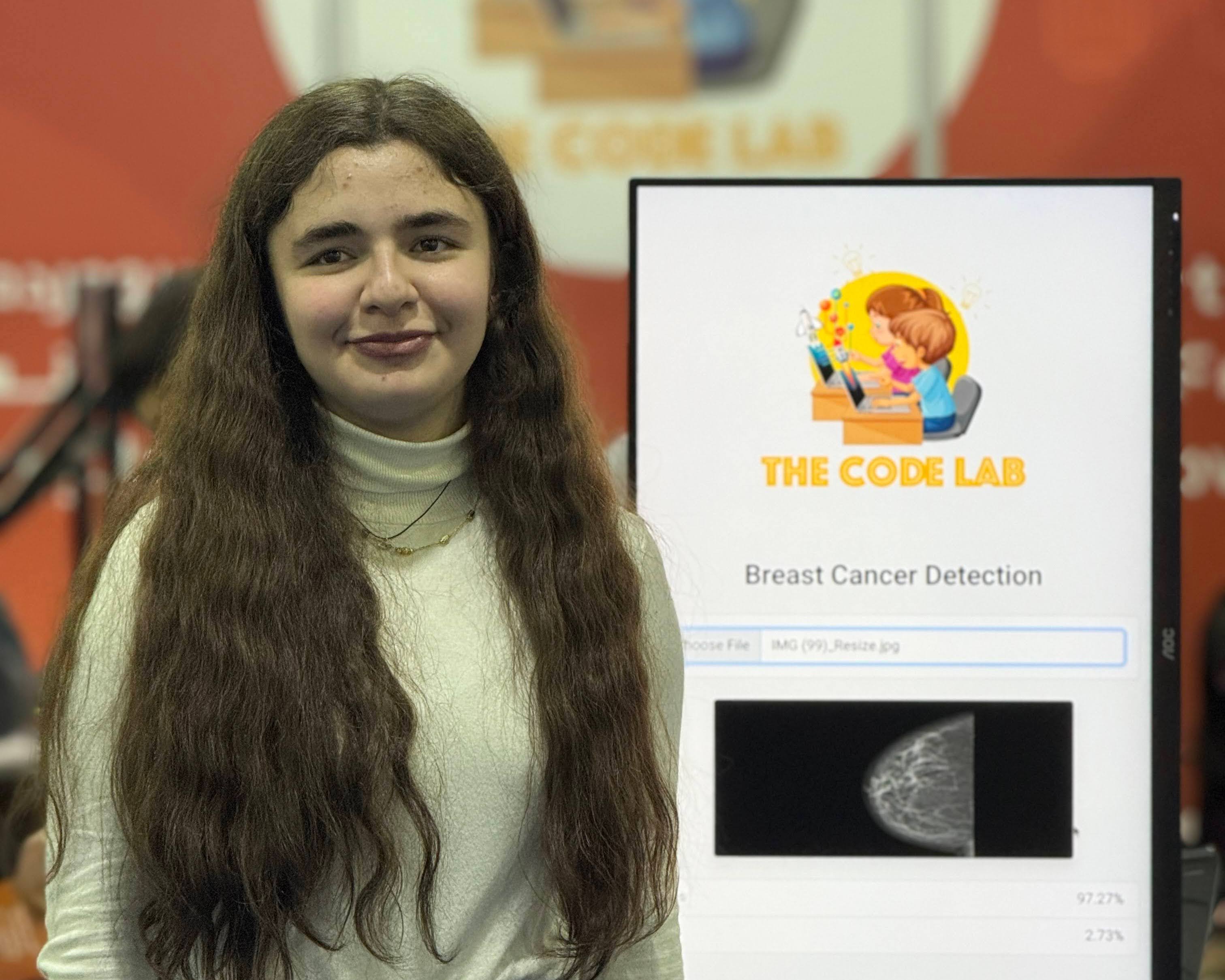
Breast Cancer Detection Tool — Student Project Showcase
Student: Rana Kovan, 9th grade, age 15 · Course: Artificial Intelligence, The Code Lab · First shown: MEDICO 2025, Erbil
Rana Kovan built an AI tool that looks at breast scan images and flags signs that may point to breast cancer. She built it in the AI course at The Code Lab, using deep learning, the same family of techniques behind modern medical-imaging research.
A year earlier, Rana did not even like technology. "Before joining, I didn't know that technology was so important," she says. "I didn't even like it. But after I started the program, I changed my mind and I like it a lot now!" Her project went on to be presented at MEDICO 2025, covered by several media outlets, and featured live on Rudaw TV during Breast Cancer Awareness Month.
Why this project matters
Breast cancer is the most common cancer in women worldwide, and finding it early is what saves lives. In 2024, about 2.4 million women were diagnosed and 694,000 died of it, according to the World Health Organization. It was the most common cancer in women in 164 of 186 countries.
The problem is closer to home than many people think. In Iraq, breast cancer made up about a third of all recorded cancer cases in 2019 and was the leading cause of cancer death among Iraqi women (Al-Hashimi, 2021). Researchers note that most Iraqi patients are diagnosed at a late stage, when treatment is harder.
WHO is clear that deaths fall when cases are detected and treated early. That is where technology can help:
- Supporting doctors. AI tools can act as a second pair of eyes on scan images, helping specialists spot areas worth a closer look.
- Reaching more women. In places with few radiologists, smart screening support can make early checks faster and more widely available.
- Breaking the silence. A project like Rana's starts conversations. When a 15-year-old talks about early screening on live TV, families listen.
Rana's tool is a student project, not a medical device. But it shows that young people in Kurdistan can build technology aimed at real health problems in their own community.
How it works
The tool uses a deep learning model, a type of AI that learns to recognize patterns by studying many examples. Rana's model learned from breast scan images that were already labeled by experts, until it could tell the difference on its own.
- Upload a scan. The user gives the tool a breast scan image.
- The AI analyzes it. The model examines the image for visual patterns linked to cancer.
- Get a result. The tool shows whether the scan shows signs that may need a doctor's attention.
"The system can help doctors and raise awareness about how important early screening is," Rana explains. "I felt proud knowing that something we made in class could be used in real life to help others."
From the classroom to live TV
Rana's project left the classroom and reached thousands of people across the region.
- MEDICO 2025, Erbil. The tool was first revealed at MEDICO 2025, Erbil's health exhibition. The Code Lab's booth, showing medical AI projects built by students, was one of the most crowded at the event. Doctors, health professionals and families stopped to see a teenager's AI analyze scan images.
- Media interviews. After MEDICO, Rana was interviewed by several media outlets, who wanted to hear how a 9th grader came to build an AI tool for cancer detection.
- Live on Rudaw TV. During October, Breast Cancer Awareness Month, Rana took part live in Rudaw TV's awareness campaign. She spoke about her project and about why early screening matters for every woman.
For a student who once had no interest in technology, speaking on live television about her own AI project was a big step. The experience built her confidence in a way no classroom alone could.
What Rana learned
The AI course at The Code Lab introduces young learners to artificial intelligence through hands-on, playful activities. Students learn how machines learn from data, and they discuss the ethical impact of AI on society. Then they build something real.
"The classes were really enjoyable, and the teachers were very kind," Rana says. "We even competed with each other by playing games we created ourselves. It made learning exciting."
Through this project, Rana gained:
- AI skills: how deep learning models are trained on images and how they make predictions
- Real-world thinking: using technology to address a health problem that affects her own community
- Responsible AI: understanding that AI supports doctors and does not replace them
- Communication: presenting to exhibition visitors, journalists and a live TV audience
Today, Rana encourages her friends to join the program. She hopes to become a dermatologist who uses AI to improve patient care, and maybe to stop illnesses before they start.
Built at The Code Lab
The Code Lab teaches children and teenagers in Erbil to build real technology: AI, programming, robotics and more. Rana's Breast Cancer Detection Tool is one of many student projects that started as a class exercise and grew into something that matters beyond the classroom.
Want your child to build the next project like this? Get in touch with The Code Lab to learn about our AI course.
Sources
- Breast cancer fact sheet, World Health Organization
- Trends in Breast Cancer Incidence in Iraq During the Period 2000–2019, Al-Hashimi, Asian Pacific Journal of Cancer Prevention, 2021